Witnesses: Soldiers Opened Fire at Wat Pathum on 19 May 2010
On 13 Dec, South Bangkok Criminal Court held witness hearings in the inquest into the deaths of six people who were killed at Pathum Wanaram Temple near Ratchaprasong intersection after the dispersal of the red-shirt protests on 19 May 2010.
The six dead were Suwan Sriraksa, 30, a farmer; Atthachai Chumchan, 28, a law graduate from Ramkhamhaeng University; Mongkhon Khemthong, 36, a rescue volunteer of the Po Tek Tueng Foundation; Rop Suksathit, 66, an airport taxi driver; Kamonkade Akkahad, 25, a volunteer paramedic; and Akharadet Khankaew, an employee.
The public prosecutor brought three witnesses to testify, including Narongsak Singmae, Tibet Puengkhunthod, and Natthathida Meewangpla.
Narongsak testified that he had been staying in a tent inside the temple since 14 April 2010. On 19 May 2010, after the UDD leaders announced the cancellation of the protests, many people came to the temple as it had been declared a sanctuary.
At 5 pm, when he was taking a rest near the temple gate, some people walked past him and told him that soldiers had already come. He thought that as the temple had been declared a sanctuary, it should have been safe. However, when looking up at the elevated tracks of the skytrain in front of the temple, he saw 6 soldiers aiming their rifles and shooting down. He was shot with 5 bullets. The first one hit a ten baht coin in the left pocket of his shirt. The second and third hit his stomach, and the fourth hit his left thigh. The fifth hit his bag. He dodged, and saw a man shot in the foot. He crawled to the back of a 10-wheeled truck and then further to a tent where he was helped by some people who put him on a deck chair and carried him to the grove at the back of the temple. He was there until about 10 pm when he was taken in an ambulance to Ramathibodi Hospital.
Tibet, a volunteer guard of the United Front for Democracy against Dictatorship, told the court that on that day after the rallies were cancelled at about 1 pm, he walked along Rama I Rd to find a way out. When he was near Chalerm Phao intersection, he heard gunshots and then ran into the temple and stayed at the temple grove. At about 5 pm, he heard a television announcement by the spokesperson of the Centre for the Resolution of Emergency Situation who said that the protesters could go to board buses at the National Stadium. He consulted with his friend and Atthachai Chumchan, the second dead person, whom he had just met at the temple, and they agreed to walk out of the temple to get to the National Stadium.
When near the same intersection, he saw soldiers at the skytrain pillars aiming rifles at them, and they turned to run back to the temple. The soldiers shot at them. They took shelter behind a skytrain pillar in the middle of the road in front of the temple. Once the gunfire ceased, he led his friends to run back into the temple. When he was inside, he heard someone shouting that someone had been shot, and then he saw that Atthachai was shot and had fallen on the traffic island. At that time, he only heard gunfire from the direction of the intersection. This took place at about 5.50 pm. Atthachai was then taken into the temple and received first aid.

Atthachai being shot at the traffic island. Photo by Steve Tickner (lightstalkers.org/steve_tickner)
Natthathida, a volunteer paramedic, witnessed the deaths of Kamonkade Akkahad, Akharadet Khankaew and Mongkhon Khemthong, whom she worked with on that day.
She said that she had worked in a medical tent in front of the Royal Thai Police Headquarters since 16 April 2010. On the morning of 19 May 2010, she, Kamonkade and Akharadet decided to move into the temple to provide help for those who took shelter there. Mongkhon came to help them at about 2 pm. Their tent was near the temple gate.
At about 4 pm, she heard gunfire from the direction of Chalerm Phao intersection, and people on Rama I Rd ran into the temple. She saw Atthachai shot and fall at the traffic island. He stood up and ran, but fell at the temple gate.
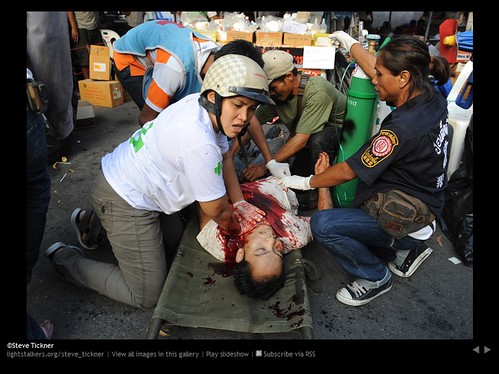
Atthachai receiving first aid. Mongkhon (right), a rescue volunteer, was shot and killed not long afterwards. Photo by Steve Tickner (lightstalkers.org/steve_tickner)
Later, she and her colleagues including Kamonkade, Akharadet and Mongkhon decided to move to the temple grove at the back as they thought that the front of the temple was no longer safe. When Kamonkade, Akharadet and Mongkhon were collecting their medical kits inside, there was gunfire. The witness, who was standing 5 meters away from the tent, called out for them to crouch down. When she turned her head to look at them, she saw that Kamonkade was crawling with difficulty towards a pick-up truck at the back of the tent, but could not make it and lay still. Mongkhon was motionless, but Akharadet seemed to be still moving. At that moment, no one could help because gunshots were being fired from the skytrain tracks all the time, as evident by sparks when the bullets hit iron poles, and dust blown up from the concrete floor and the holes made by the bullets. The witness took shelter behind flower pots with a foreign reporter named Andrew (last name unknown to her). The reporter was shot when he raised his knee.
Akharadet struggling in pain, Kamonkade lying dead nearby.
The witness then went to the temple grove to seek help for them. Kamonkade and Mongkhon were already dead, but Akharadet was still alive. At about 7 pm, the bodies were retrieved and Akharade was rescued, but he died about an hour later. An ambulance finally came at about 11 pm, after it had first been called at 6 pm. The witness said that if the ambulance could have come earlier, Akharadet’s life should have been saved.
She insisted to the court that during the gunfire she saw 5 soldiers in military fatigues on the skytrain tracks wearing helmets with pink stickers on the back. The soldiers were aiming their rifles into the temple. She did not see anyone firing or hear gunfire from the temple. And on that day, she, Kamonkade and Akharadet were wearing red-cross armbands, and Mongkhon was wearing the uniform of the Po Tek Tueng Foundation. According to international practice, they should have never been harmed by either side in the conflict, she said.
The next hearing will be on 20 Dec.


Comments
How can these Thai soldiers
How can these Thai soldiers wield their weapons of war against the Thai people, purposefully and cowardly killing these ordinary, unarmed Thai people in cold blood, ordinary Thais who'd taken refuge in a Buddhist temple in the City of Angels?
What happens to people when they join the Royal Thai Army?
What monstrous program of dehumanization can be run by the Royal Thai Army that makes Thais capable of the cowardly, cold-blooded murder of their unarmed compatriots? Who'd taken refuge in a Buddhist temple?
The Royal Thai Army puts the lie to everything said of Thailand.
The Royal Thai Army seems clearly to be the greatest enemy of the ordinary mass of Thai people, the greatest destroyer to their physical well-being and sanity, whether it is murdering them or making murderers of them.
The new constitution must deconstruct the Royal Thai Army. Offer early retirement to everyone above the rank of colonel and make 77 new Thai defense forces under strict civilian control in each of the provinces of Thailand.
Never again. Those must become the watch words with regard to the Royal Thai Army run murderously amuk amongst the Thai people.
Never again.
"What happens to people when
"What happens to people when they join the Royal Thai Army?
What monstrous program of dehumanization can be run by the Royal Thai Army that makes Thais capable of the cowardly, cold-blooded murder of their unarmed compatriots? Who'd taken refuge in a Buddhist temple?"
It's just royalist-nationalism. Nothing special. What is so radical in the army, you ask? = Royalist-nationalism. There is no brand of kwam phen Thai that is not extreme. These same sorts of people commit the same violent acts (or support them) even without being in the army, so you see the military training in itself is not really to blame, aside the fact it cements the royalist-nationalist persona (which was already there).
If as she says the soldiers
If as she says the soldiers were aiming there rifles at them in the temple, then the soldiers would have been facing them. How could she have seen pink stickers on the back of her helmets? Seems like a little coaching here.
Despite what you may think
Despite what you may think solders are human and like the rest of us move around and sometimes look over their shoulders. When they are shooting unarmed civilians they would feel free to move around.
Or are you saying there were no solders on the sky track? There is plenty of video and photographic evidence.
Come on, Jim, you make it a
Come on, Jim, you make it a little bit too easy for yourself, no? The soldiers stood on a line spanning many meters, and they turned their heads from time to time, partly to talk to each other, thereby exposing the labels on the backs of their helmets. This is quite possible, right?
John Francis Lee.... thank
John Francis Lee.... thank you very much for your specific statement of a solution to this madness in Thailand
Don't worry Abhisit and his
Don't worry Abhisit and his deputy PM. will not be found guilty of anything in a Thai court, and I mean anything, from a parking offense to High treason. Royalist elite cannot be guilty.
If this case gets to court, which I doubt, it will be interesting to see what verdict they find for the deaths and injuries of these people. I would imagine death by misadventure, justifiable homicide, act of God, something like that.
A and T will more than likely get a medal of honor for protecting King and country from the ugly mob.
Unfortunately, some people
Unfortunately, some people died...said Abhisit Vejjajiva, former Thai PM now a Satan.
Just to add that the first
Just to add that the first hard evidence against the soldiers was uncovered by Thai Rath newspaper when their reporters visited the track and published photographs of used shell casings and empty water bottles thus countering the blanket denials from the thai army.
I'm sorry but I don't agree
I'm sorry but I don't agree with the one-sided sympathetic view-point of the comments here, they are unqualified unless considered in the greater context of what happened at Ratachaprasong. Soldiers did fire live bullets, they were positioned on the sky train, the temple was supposed to be neutral, people did die there. Sounds like a slam dunk case against Abhisit for ordering in the murderous elite supporting army. Wrong. Consider this; (next posting)
1. The UDD and red shirts
1. The UDD and red shirts were not exclusively a peaceful protest group campaigning for democracy, there were armed people among them firing at civilians and the army, and the leadership failed to control this.
2. This was not just a protest against undemocratic process, it was a planned, well organised and funded attempt to force an elected (yes elected) govt to quit.
3. Given how the events unfolded, such as the symbolic spilling of blood at parliament house, it's very plausible to suggest that certain hawkish elements among the UDD leadership set out to force the govt to come in and 'spill blood', they are not entirely free of culpability in the deaths.
4. The protest was protracted and disruptive to the nation and capital city and would never have been tolerated for 6 weeks in any other country, the prime minister was lenient and exhausted his options to negotiate, we still need to know specifically why the offer was accepted then turned down, no good reason was given, but it forced Abhisit's hand.
5. Since a state of emergency existed, quite justified under the circumstances, those on site would have known that it was a 'war zone' and potentially dangerous, they had ample chance to leave.
6. While you can designate a no fire zone for humanitarian purposes, such as the temple, it's unrealistic to expect it to be miraculously free of fire, it was in the middle of a chaotic war zone with two sides firing at each other, bullets whizzing back and forth, mercenaries taking advantage of the temple to provide cover and fire back, in short; shoot a bullet from a barrel and it's not going to suddenly stop and go around the temple.
7. In a clash like this, collateral damage, including civilians, press and red cross staff remains a realistic risk that is typical of any conflict zone, I doubt the soldiers deliberately targeted the temple, they knew it would make them look bad, they had a thankless task to do, protecting a nation from a group of determined, armed, insurgents, it's wrong to call them lackeys who shot their own people.
Nice try, BUT there were a
Nice try, BUT there were a lot more deaths & injuries than would/could/should be attributed to so called 'collateral damage'.
Consider this. No soldier was
Consider this.
No soldier was shot dead by the redshirts or men in black etc.
Was any soldier shot and wounded apart from through friendly fire?
Where we were the soldiers stayed at 300 meters distance from the red shirts behind their tyre barricades and just picked them off. You can't fire a firework 300 meters nor a slingshot nor a ping pong bomb.
At Wat Pathum the soldiers fired down at red shirts outside the temple who ran in to join the other 2000 or so seeking sanctuary and they just kept firing at anything they could spot including shooting the nurse 5 times.
The soldiers shot at anyone and anything.
150,000+ rounds and 2500 sniper rounds.
The suggestion above of bullets whizzing back and forth by Jono is monstrously untrue.
It was one way traffic. Sure there were incendiary devices,some army grenades, fireworks, some hand guns even and the army were letting off devices too like outside Paragon to create diversions.
When will we learn the truth as to why the fire brigade were prevented in going to tackle the CentralWorld fire for example?
The UDD says the army, some 30,000 in Central Bangkok with a further 30,000 stationed around, prevented the firetrucks from entering.
Abhisit claimed the red shirts prevented the fire brigade.
Who's telling the truth?
"Determined armed insurgents."
Here we have the re-writing of history.
This is the Abhisit theme who lately accused the red shirts of not returning all army weapons seized from the army on April 9th outside the UDD transmitter station.
He didn't say it at the time though did he?
So how does one check the veracity of what he says now?
It was a propaganda coup for the UDD when they displayed weapons seized and handed over and returned to the army.
Later the army sneaked back and seized the transmitter back.